

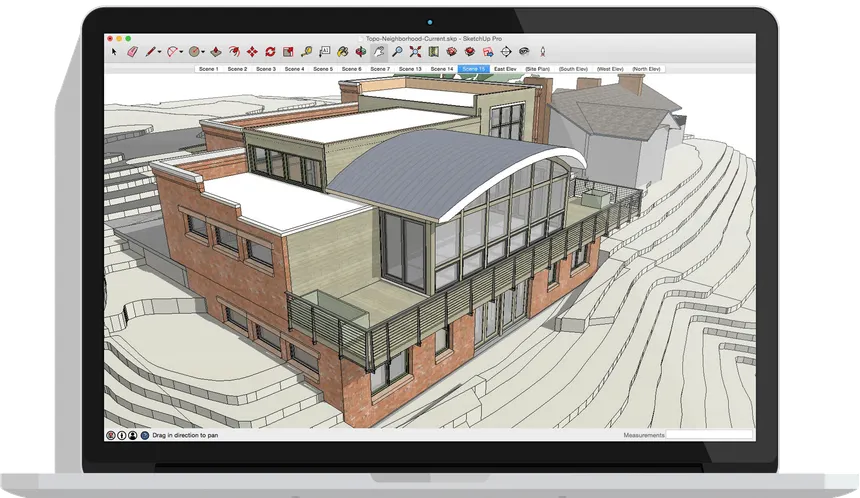
For decades, natural stone has been specified through samples, PDFs, and long email threads. An architect would fall in love with a slab in a showroom, send a 2D drawing to the supplier, and hope that what arrived on site matched the original vision.
Today, that process is being rewritten inside BIM.
Building Information Modelling (BIM) is no longer just a 3D modelling tool. For many studios and contractors, it’s becoming the primary environment where products are discovered, evaluated and specified. If a material doesn’t exist as a smart BIM object, in many projects it simply doesn’t enter the conversation.
Natural stone is no exception.
From texture images to intelligent stone objects
The first step many manufacturers took into BIM was to publish simple Revit families or material textures: a name, a colour, maybe a rough thickness. Helpful for visuals, but not enough to support real design decisions.
Architects who work with stone know they need more:
- Exact geometry and cut-to-size layouts for façades and interiors
- Performance data such as strength, slip resistance, frost resistance
- Finish and veining options for design intent
- Cost and lead time information to keep projects realistic
- Environmental and maintenance data to support sustainable design
Recent research on the Portuguese ornamental stone sector shows that when stone is represented only by rigid, standardized BIM objects, architects often switch to other materials that fit better in BIM-based procurement: designers struggle to adapt it to their actual façade geometry, coordination becomes painful, and alternative materials – often more standardized and cheaper – win the specification.
In other words: if natural stone is “dumb” in BIM, it quietly disappears from the project.
What changes when stone BIM objects are done properly
When stone BIM content is designed around real workflows, the story looks very different.
In several projects and research pilots, architects and engineers have been able to:
- Configure cut-to-size stone façades directly in BIM
Adjusting module sizes, joints and patterns in the model, while the system generates the corresponding list of stone elements that can actually be produced. - Explore finishes and slab layout before fabrication
Working with digital samples and, in advanced cases, with digitised slabs and veining, so that book-matching, vein continuity, or special patterns are decided early – not improvised on site. - Connect design to a “mini-factory” in the background
Once the layout is approved in BIM, production data is sent to the supplier’s systems, where slabs are optimised, cut and finished with full traceability. - Keep a digital “passport” for each stone element
Installation instructions, maintenance procedures and replacement information stay linked to the same objects throughout the building lifecycle.
In these scenarios, BIM is not a threat to stone’s uniqueness.
It becomes the bridge that connects architectural intent, factory capabilities, and long-term performance.
Why this matters for stone suppliers
For quarry owners and stone processors, the shift to BIM procurement is strategic.
Architects increasingly search within BIM platforms and object libraries when they start a project. They compare options based on data: performance, sustainability, cost, availability. If a stone is missing from that environment – or is present only as a generic, inflexible object – the chances of it being selected drop dramatically.
On the other hand, supplying well-structured, high-quality stone BIM objects:
- Puts your materials directly into the architect’s design workflow
- Reduces friction and misunderstandings during detailing and tender
- Demonstrates performance and sustainability with real data
- Positions your company as a digital partner, not just a commodity supplier
In short: BIM is where specification decisions are made.
Natural stone needs to be there in a way that reflects its real value.
How StoneArchiBIM fits in
StoneArchiBIM was created precisely to close this gap between quarries and digital design.
We help:
- Quarry owners and stone producers translate their materials into smart BIM objects, with technical data that makes sense for architects.
- Architects and designers access reliable, project-ready stone content they can use confidently in Revit and other BIM tools.
Our work is inspired by real case studies where BIM has already transformed how natural stone is specified, produced and maintained.
If you want your stone to be part of the next generation of BIM-driven projects, it starts with how it appears in the model.
👉 Want to explore BIM for your natural stone?
Contact us and let’s talk about how to bring your quarry into the digital design world.